
Europe
Lane is Available
Import and Export to Serbia
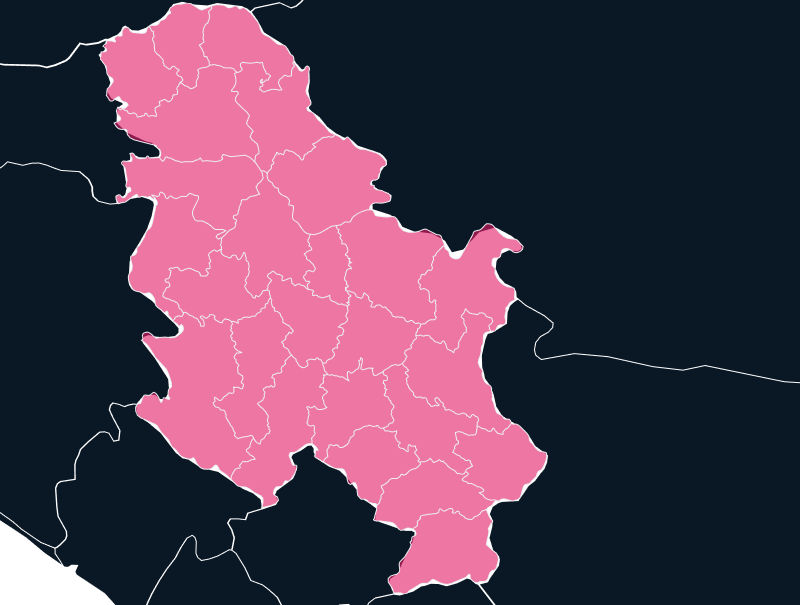
Serbia, located in the heart of Southeastern Europe, offers unique opportunities and challenges for international trade. While not yet a member of the European Union, Serbia’s growing tech sector and strategic position make it an attractive hub for businesses aiming to expand in the region.
Tax
Up to 20%

Duties
Up to 15%

Lead Times
3-4 Weeks
Restricted Items
Second-Hand and Refurbished Goods, COO Restrictions

Best Carrier Option
Courier or Freight Forwarder

Non-Working Days
Saturday, Sunday, and Public Holidays

Prominent Languages
Serbian
Global Trade Compliance in Serbia
Serbia’s import market has specific regulations issued by the Ministry of Finance and the Ministry of Information and Telecommunications designed to ensure that goods, especially advanced technologies, telecom, and ICT equipment, are properly monitored, imported, and exported. Compliance in Serbia is strictly enforced by the Customs Administration of Serbia (Uprava Carina) and RATEL (Regulatory Authority for Electronic Communications and Postal Services).
When importing into Serbia, the customs declarant is legally required to be an entity registered with Serbian Customs and established in the Republic of Serbia. Serbia’s customs authorities also have several strict requirements for tech trade, such as specific permits for dual-use items and wireless devices.
Importing and exporting to Serbia is not easy with these stringent regulations, meaning your high-tech imports require specialized knowledge, certifications, and expert handling to avoid supply chain disruptions. Foreign companies without a Serbian entity need a designated Importer of Record (IOR), a legally designated entity that assumes full responsibility for customs clearance.
Population
6.5M
Biggest Industry by Export
Electrical Machinery, Insulated Wire, and Copper Ore
Capital City
Belgrade
Biggest Industry by Import
Electricity and Electronics
Importer of Record in Serbia
Businesses can face significant hurdles when importing to and exporting from Serbia. These challenges range from ensuring compliance to overcoming tariff barriers and handling inspections.
The Ministry of Economy issues specific rulebooks and regulations that define legal requirements for safety and compatibility, such as the Electromagnetic Compatibility (EMC) and Low Voltage (LVD) rulebooks, which all importers must adhere to. Goods brought into Serbia must be covered by an Entry Summary Declaration, as well as adhere to the Customs Law, Customs Tariff Law, and have applicable EMC, LVD, safety, and Declaration of Conformity (DoC) documentation.
Foreign entities without a local footprint rely on a Serbian IOR to manage Serbian VAT settlement, SEF e-invoicing compliance, and SEPA reporting. Without the proper documentation, tech shipments could face extended delays at customs or even be rejected outright. This is where TecEx, an Importer of Record in Serbia, comes in. Our tailored solutions are designed to make your trade operations as smooth and efficient as possible.
Did You Know?
Serbia is not yet a member of the World Trade Organization (WTO), meaning that some of its trade practices still differ from those of other global markets. While the country has made efforts to align its customs procedures with WTO standards, challenges related to transparency, procurement procedures, and regulatory consistency remain. Despite this, approximately 75% of EU regulations have been incorporated into Serbian law, and the country continues to harmonize with the European Union’s trade regulations.
How Do IOR Services in Serbia Work?
As your IOR, TecEx assumes all the legal risks and responsibilities associated with the import process.
We handle all necessary customs documentation, apply for any required permits, and maintain close contact with customs authorities to ensure your goods are cleared without delay. We stay up to date on requirements for global trade compliance in Serbia, so you don’t have to.
When working with TecEx, you transfer the legal risk to us and you will gain peace of mind knowing your goods are covered with 110% Cargo Liability Cover by experts knowledgeable in Serbia’s trade compliance.
DDP Services in Serbia
Our services include DDP (Delivered Duty Paid) shipping in Serbia, where we assume full responsibility for the door-to-door global delivery of your tech goods, simplifying the importation process. Even if you do not have a local entity in Serbia, our IOR EOR services enable you to import and export goods with confidence without establishing a physical presence. Our quotes include accurate duty calculations, preventing unexpected costs and border complications.
Pain Points of Importing and Exporting to Serbia
It’s vital to understand the challenges importers face in Serbia to streamline your tech trade.
Serbia has several trade compliance rules that importers must follow, including the E-Delivery Mandate, VAT Law Amendments, SEF integration, e-waste controls, and potential environmental fees. Serbian authorities frequently conduct inspections to verify the contents of shipments against the provided documentation and follow all country-specific rules.
Wi-Fi/Bluetooth devices must comply with Serbia’s Rulebook on Radio Equipment, and RATEL oversees the telecom and internet service provider (ISP) market. ICT type-approval nuances are prevalent too, as seen with the Serbian Conformity Mark (3A), encryption hardware permits, and dual-use export control alignment. Additionally, CE marked products generally require to have the 3A mark too. Importers need to understand which products are subject to these regulations to avoid complications during customs clearance.
Serbia maintains an aggressive stance on protecting Intellectual Property Rights (IPR) at the border, which can lead to delays for importers of high-tech branded goods. If an importer is found to have provided incorrect information to obtain a reduced duty rate or preferential origin, they face fines of 1 to 4 times the customs duties payable, creating a high-risk environment for complex technology valuations.
In addition to these risks, goods in temporary storage must be assigned a procedure or re-exported within 90 days; failure to meet this deadline is punishable. Non-EU-origin goods shipped from EU warehouses don’t get duty-free entry.
Any discrepancies or non-compliance found by Serbian customs authorities will result in significant fines, additional charges, or clearance delays. Factoring the impacts of these rules into your shipment planning is vital for accurate pricing and logistics strategies, something TecEx assists with.
Regulations for Global Trade Compliance in Serbia
As seen above, importing tech goods into Serbia often requires licenses, particularly for dual-use products and medical equipment, all of which must use the correct Harmonized System (HS) codes. These products are subject to international conventions and obtaining the necessary import permits ensures compliance with local regulations.
Serbia’s Customs Tariff Law provides a systematic nomenclature for goods and sets the rules for calculating import duties. It mandates alignment with the European Union’s Combined Nomenclature to ensure consistency and transparency in international trade. When it comes to trade with Kosovo, special customs conditions apply, a longstanding point of contention for exporters. Though trade between Serbia and Kosovo has resumed, tensions and tariffs still complicate their overall trade relations.
E-Delivery Mandate
Serbia has introduced a mandatory Electronic Delivery Note (E-Transport) system called e-Otpremnica.
Paper consignment notes are being replaced by electronic notes and transporters must be able to present the digital note for inspection during transit.
While the current 2026 phase targets public transactions and excise items, the Serbian government will expand this mandate to cover all remaining private B2B transactions starting 1 October 2027. Non-compliance fines can reach closely up to $20,000.
VAT Law Amendments & SEF Integration
All companies using the Electronic Invoicing System (SEF) must prepare internal invoices, such as reverse-charge invoices, within SEF, and on time, to claim the related input VAT deduction. SEF will begin generating preliminary VAT returns for tax periods starting January 1, 2027.
Businesses can deduct input VAT on domestic purchases only if the supplier’s e-invoice is accepted in SEF by the day before the VAT return is filed. Import VAT works differently: it is paid to Serbian Customs at clearance, recorded in SEF from customs data, and recoverable only by a Serbian VAT-registered entity.
Dual-Use and Strategic Controls
As a candidate for EU membership, Serbia is increasingly aligning with the EU’s 2025/2026 Dual-Use List updates. Serbia is also aligning its export and import controls with the EU Dual-Use Regulation (EU 2021/821).
High-performance computing hardware, AI servers, advanced GPUs, and cryptographic hardware face increased customs scrutiny and require licenses from the Ministry of Internal and Foreign Trade.
Expect longer lead times for importing encryption software or advanced networking gear, as Serbian authorities are more actively reviewing technical specifications for high-risk digital infrastructure.
E-Waste and Environmental Fees
Serbia has intensified its focus on the Circular Economy, which affects hardware imports. Ecological Tax (Eco-Taksa) applies to products that become special waste streams after use.
The weight of imported laptops, monitors, or batteries must be reported, and a corresponding fee must be paid to the Environmental Protection Agency (SEPA) quarterly. Used and refurbished IT hardware require waste management permits, issued by the Ministry of Environmental Protection.
TecEx’s shipping experts are well-versed in tech trade with Serbia and can help you navigate these complexities. We provide professional expertise in tariff classification (to avoid misclassification penalties), managing complex valuation rules, and ensuring adherence to Serbian-specific technical rulebooks and regulations.
Leading Trade Partners of Serbia
Europe
Italy
Asia
China
Your Global Trade Solution for Serbia Import and Export
Streamline your trade with Serbia today! Get in touch with our experts for your import and export needs.