Guide to Understanding Cargo Insurance
For businesses shipping high-value tech equipment, a single incident can result in significant financial loss and logistical challenges. Understanding exactly how cargo insurance works and where standard coverage often falls short is essential to protecting your business.
Major events impacting supply chains, such as severe weather or global disruptions, are not everyday occurrences. But, as soon as multiple parties are involved in the movement of goods, mistakes can happen. This can be something like a delivery person dropping your package or a consignment shifting within a container, denting the equipment.
Effective supply chain risk management means that your business is less likely to be impacted by these often unforeseeable disruptions. Real-world incidents show just how quickly and how expensive risks can be. In 2025, the containership Evergreen Vessel suffered damage to approximately 40 of its containers as a result of a storm just off the coast of Rio Grande, Brazil.
This is where cargo insurance becomes critical. Cargo insurance protects your business from financial loss when unexpected events disrupt your shipment.
Clients often assume that outsourcing shipping to freight forwarders or couriers guarantees cargo safety and liability coverage for any damage. However, cargo insurance and freight forwarder insurance protect different policyholders, making understanding this distinction critical.
Before we get into the nuances of cargo insurance, let’s discuss cargo. Cargo can include everything from aerospace parts to food to high-value technology, and even regulated dangerous goods, including lithium batteries.
The owners of these goods are either the manufacturers (e.g., OEMs), sellers (e.g., distributors or VARs), or the eventual owners (end-users).
Why Your Carrier Isn’t Liable for Cargo Loss
You may assume that the freight forwarder or carrier will be liable for any damage occurring during shipping. Unfortunately, however, logistics providers are typically only responsible when negligence can be proven, and even then, the compensation will be limited.
Alternatives would be to either rely on partial or limited cover from a carrier, or risk it all.
The Different Types of Insurance
What is Cargo Insurance?
Cargo insurance protects the value of the cargo being shipped from a range of potential situations.
Coverage can apply across multiple transport modes, including:
However, many traditional policies include exclusions and limitations hidden within terms and conditions. Coverage levels may vary depending on cargo value, product type, destination, and mode of transport.
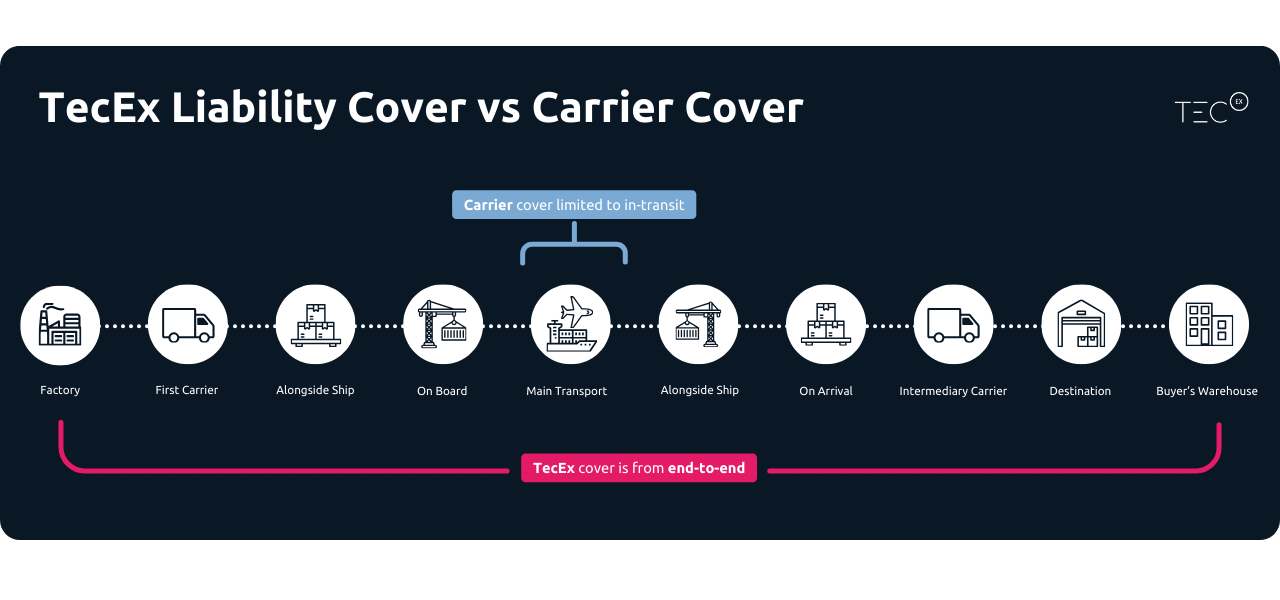
TecEx’s fully comprehensive 110% liability cover ensures your high-value tech goods are covered for any damage or loss from pickup to final delivery.
What is Marine Cargo Insurance?
Marine transport remains the backbone of global trade, accounting for more than 80% of goods transported.
Marine cargo insurance applies specifically to goods transported via ocean freight. However, while it provides protection during ocean transit, coverage may not extend across the entire logistical journey, leaving gaps in the insurance coverage.
In markets such as Kenya, marine cargo insurance is not only a risk management tool but also a legal requirement for imported goods, under the Marine Insurance Act.
What is Freight Forwarder Insurance?
Freight forwarder insurance is an alternative form of cover offered by logistics providers.
Freight forwarder insurance protects the freight forwarder’s liability from circumstances that lead to the damage or loss of cargo. In essence, this insurance protects the freight forwarder company. Furthermore, in the event of a claim, the value is generally determined by the cargo’s weight, not the cargo value. This is detrimental for businesses shipping high-value tech, where goods often weigh less but cost far more.
Shipper insurance lapses when the goods are delivered in the country, all in line with the air waybill. Your goods are not covered for the entire journey to the destination point.
How to Choose the Cargo Cover You Need
Selecting the appropriate cargo insurance coverage requires understanding both operational risks and liability gaps. Businesses need to evaluate:
TecEx’s Door-to-Door Liability Cover Solution
Understanding the nuances of cargo insurance can help you choose the right protection for your shipment.
Many providers hide the true extent of their liability coverage in complex terms and conditions. TecEx does not; we are fully transparent about exactly what is covered.
We trust our partnerships and procedures to ensure our clients experience risk-free shipping. We protect your cargo from pickup through to final delivery. Be it a drayage movement, domestic shipments or global shipments crossing miles, it is covered.
Hassle-Free Trade Compliance Solutions
As you can see from our wealth of knowledge, TecEx is your go-to partner for global trade management. With our trade compliance solutions, your IT supply chain will operate without hitting any roadblocks. We help you meet compliance requirements, navigate sanction changes, take advantage of free trade agreements, and more.
See the TecEx difference today.