ECCN Classification for Tech and Dual-Use Exports
The ECCN is the code that tells you whether your tech hardware needs an export license, where it can go, and who can receive it. For OEMs, distributors, resellers, data center operators, and AI teams that ship across borders, it is the first compliance decision for every shipment.
TL;DR
- An ECCN is a five-character code on the US Commerce Control List (CCL) that identifies items controlled for export.
- A combination of the ECCN, destination, end user, and end use determines whether you need a license.
- Most IT hardware is controlled due to encryption or computing performance.
- US rules follow US-origin items and technology abroad, so non-US companies are often in scope.
- Destination countries add their own export, import, and encryption rules on top.

Each piece of hardware or software built that leaves the United States, or contains US-origin technology, carries an export classification. While the Export Control Classification Number (ECCN) is a US code, it is not only for US exports. It also concerns products of US origin for re-export, or any foreign product that contains sufficient US IP.
The EU, the UK, China, and India run their own dual-use control lists, so non-US shippers often need to check both. Get that classification wrong, and the problem is not a paperwork correction. It can mean an unlicensed export, a shipment held at the border, and penalties that often exceed the value of the hardware.
What is an ECCN?
An Export Control Classification Number (ECCN) is a five-character alphanumeric code on the US Commerce Control List (CCL) that identifies commodities, software, and technology subject to export controls. It is part of the Export Administration Regulations (EAR), administered by the Bureau of Industry and Security (BIS), and it determines whether an export, reexport, or in-country transfer needs a license.
ECCNs describe products technically, not commercially. Two products that look alike in a catalog can carry different ECCNs due to differences in processing performance, encryption functionality, frequency range, or other measurable parameters.
If an item is subject to the Export Administration Regulations (EAR) but not described in any ECCN, it is designated EAR99. EAR99 items usually ship without a license, but they can still need one for a restricted end user, end use, or destination.
How an ECCN is Structured
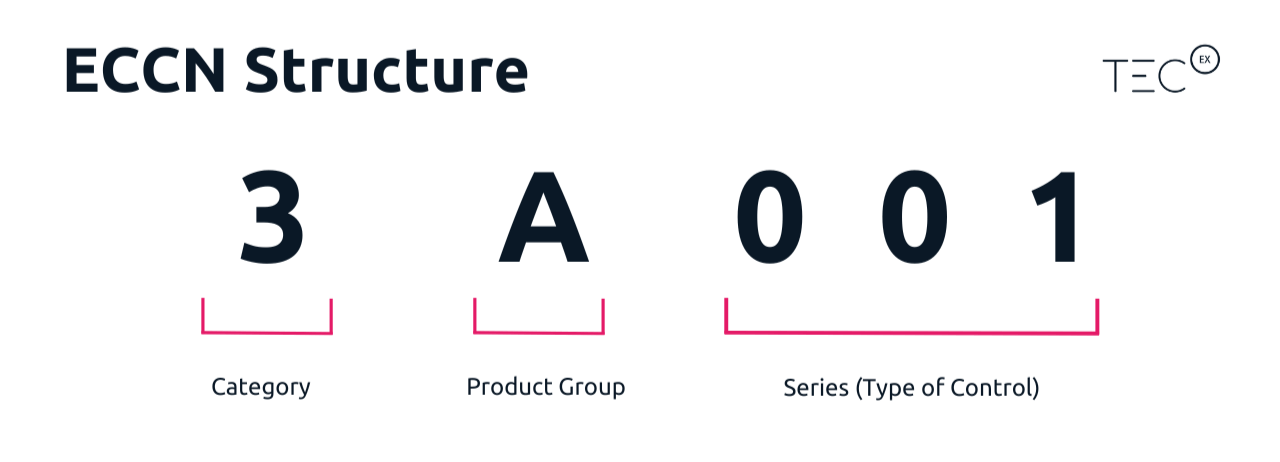
The ten categories are:
- 0 Nuclear and miscellaneous
- 1 Materials and chemicals
- 2 Materials processing
- 3 Electronics
- 4 Computers
- 5 Telecommunications (Part 1) and information security (Part 2)
- 6 Sensors and lasers
- 7 Navigation and avionics
- 8 Marine
- 9 Aerospace and propulsion
The five product groups are:
- A Systems, equipment, and components
- B Test, inspection, and production equipment
- C Materials
- D Software
- E Technology.
The last three digits also signal why the item is controlled. Entries in the 0xx to 3xx range are generally multilateral controls, while 9xx entries, such as 5A992, are mostly controlled for anti-terrorism reasons only.
Why Getting the ECCN Right Matters for Tech Exports
A wrong ECCN can make a licensed export look license-free, apply a license exception that does not fit, or file inaccurate export data. Each of those can be a separate violation. Penalties are assessed per violation, and each shipment can be a separate violation, so risk exposure scales with volume.
The consequences can vary from:
Not sure your current classifications would hold up in an audit? Talk to a TecEx compliance specialist before your next shipment.
ECCNs That Apply To IT, AI, and Dual-Use Hardware
Most tech hardware is controlled for two reasons: the encryption it uses or the computing performance it delivers. Some common ECCNs include:
| Hardware Type | ECCNs to check | What drives the classification |
|---|---|---|
| AI accelerators, data center GPUs, and advanced logic chips | 3A090 (.a, .b, .c) | Computing performance thresholds. Most GPUs fall under 3A090 or 3A991 |
| Servers, systems, and assemblies containing 3A090 chips | 4A090 | Whether the system contains 3A090 integrated circuits |
| Network infrastructure: routers, switches, firewalls, VPN gateways | 5A002 / 5D002 | Network infrastructure items under 740.17(b)(2) are not eligible for mass market treatment |
| Items not described on the CCL | EAR99 | Still licensable for embargoed destinations and restricted parties |
The above information has been collated from: Greenberg Traurig, Wilson Sonsini, and BIS.
ECCN vs HS, HTS, Schedule B, EAR99, and ITAR
An ECCN is distinct from and unrelated to Schedule B and HTS codes. Most cross-border tech shipments need several of these codes at once, each for a different authority.
| Code | Purpose | Who maintains it | Used on |
|---|---|---|---|
| ECCN | Export control: Is a license required? | BIS, US Department of Commerce | Export licensing, EEI filings, commercial documents |
| EAR99 | Designation for items subject to the EAR but not on the CCL | BIS | Same as ECCN |
| HS Code | International tariff classification (6 digits) | World Customs Organization | Customs declarations worldwide; drives duties and many import permits |
| HTS Code | US import tariff classification (10 digits) | US International Trade Commission | US import entries and duty calculation |
| Schedule B | US export statistics (10 digits) | US Census Bureau | EEI filings in AES |
A common error is using the HS code to decide export control status. HS codes tell you duties and import requirements; they never tell you whether a US export license is needed. Read more in our guide to the Export Administration Regulations.
How TecEx Assists with ECCN Classifications
ECCN classification is not just a paperwork requirement. It determines where you can ship, whether you need a license, and whether your company is exposed to civil or criminal liability. Whether you are a manufacturer, distributor, software developer, or integrator, understanding your ECCN is foundational to lawful international trade.
If your organization exports products, software, or technology from (or containing content from) the United States, ECCN classification is not optional. It is a core compliance obligation. Let TecEx guide you through these complexities and help your business scale across borders without challenges.
Hassle-Free Trade Compliance Solutions
As you can see from our wealth of knowledge, TecEx is your go-to partner for global trade management. With our trade compliance solutions, your IT supply chain will operate without hitting any roadblocks. We help you meet compliance requirements, navigate sanction changes, take advantage of free trade agreements, and more.
See the TecEx difference today.