
Dual-use goods are classified based on their potential for both military and civilian applications. Yet classifying dual-use goods is far from simple
Take what happened in January 2026, when China halted exports of certain dual-use goods to Japan amid security tensions. Supply chains stalled, compliance teams scrambled, and businesses were reminded of a stark reality: shipping dual-use goods is challenging.
What are Dual-Use Goods?
Simply put, dual-use goods are products and technology designed for civilian use that can also support military, defense, or surveillance applications.
For exporters, these goods are subject to strict export controls, and one misstep can trigger steep fines, cargo seizures, or customs delays.
Here are some common examples of dual-use goods:
| Civilian Application | Military Application | |
|---|---|---|
| Technology e.g. GPS | Beverage cans, construction | Military aircraft frames |
| Materials
e.g. Aluminium | Navigation and logistics | Military operations |
| Software | Secure online transactions | Encryption technology to hide illegal activities |
| Hardware | Telecommunications | High-powered lasers, which can be employed for targeting, range finding, and even directed-energy weapons |
Understanding ECCN, EAR99,and ITAR for Dual-Use Technology
ECCN codes, EAR99, and ITAR are all parts of the US export control system, but they govern different categories of items and are managed by separate agencies:
What are ECCN Codes ?
ECCNs classify dual-use items listed on the Commerce Control List (CCL) and are administered by the US Department of Commerce. They help determine whether an export license is required based on the item, destination, and end use.
What is an EAR99 Classification?
EAR99 is the classification for items that do not (in most cases) need an export license. This primarily applies to low-tech consumer goods. However, the exporter must still exercise due diligence in these instances to ensure that goods are not entering an embargoed country or an end-use that requires an export license.
What is an ITAR Classification?
ITAR exists to track military- and defense-sensitive material. The International Traffic in Arms Regulations (ITAR) is the United States regulation that controls the manufacture, sale, and distribution of defense and space-related articles and services as defined in the United States Munitions List (USML), which is accessible only to US citizens.
| Code | Administered By | Covers | Examples |
|---|---|---|---|
| ECCN | Bureau of Industry and Security (BIS) | Dual-Use Items on the Commerce Control List (CCL). | High-performance computers, encryption software. |
| EAR99 | Bureau of Industry and Security (BIS) | Items not on the CCL but that require some export controls. | Certain types of civilian aircraft and some chemicals. |
| ITAR | Department of State | Defense Articles and Services. | Firearms, ammunition, fighter jets. |
The Challenges of Shipping Dual-Use Goods
Balancing Trade and Security
Striking a balance between promoting economic activity through trade and safeguarding national security is a constant struggle. Strict regulations can hinder legitimate businesses, while lax controls can enable the proliferation of dangerous goods.
Different Regulations in Different Countries
The absence of a universally standardized approach to controlling dual-use goods creates a complex landscape. Countries often have varying regulations and enforcement capabilities, making it difficult to ensure a consistent level of control.
Rapidly Evolving Technology
Advances in AI, semiconductors, and computing blur the line between civilian and military use even further, and often faster than regulations can adapt.
Classification Complexity
Determining whether an item qualifies as dual-use isn’t always straightforward. Grey areas are common, especially when components are embedded within larger systems.
The Risks of Diversion
Malicious actors can exploit loopholes or weaknesses in the system to divert dual-use goods for unauthorized military purposes. This can be achieved through deceptive practices like falsifying documentation, using seemingly legitimate companies as fronts, or engaging in transshipments through third countries.
Enforcement Gaps
Monitoring global trade requires international cooperation and substantial resources, with enforcement standards varying.
What to Do If You Need to Import/Export Dual-Use Technologies
Shipping dual-use technology comes with export controls and complex regulatory responsibilities. With controls such as ITAR, EAR, and destination-specific licensing requirements, even minor mistakes can lead to stuck shipments and escalating demurrage fees.
TecEx has extensive experience in facilitating the import of dual-use goods across international borders, ensuring full compliance with all required regulations. We can help you:
- Classify products correctly
- Secure the required licenses and permits
- Help ship to 200+ destinations
- Ensure all documentation is compliant
- Liability Cover
Our expertise ensures smooth international trade operations, allowing you to focus on growth and expansion.
How are Dual-Use Goods Classified?
Classifying dual-use goods for both civilian and military use can be challenging. The process is hindered by a host of complexities in global trade. Such as:
What Are the Consequences of Incorrectly Classifying Dual-Use Goods?
- Shipments delays
- Hefty fines
- Forced storage, which is costly
- Risk of demurrage charges being imposed on shipments.
- Long-term reputational damage
More critically, misclassification poses national security risks by allowing sensitive technology to fall into the wrong hands.
Accurate classification isn’t optional. It’s a business safeguard.
Who Controls Dual-Use Technology?
Various government bodies are responsible for their trade control regulations to manage the movement of dual-use goods. Government agencies, often under the Departments of Commerce, trade, or Foreign Affairs, are responsible for enforcing these regulations.
These regulations outline:
- Classification Systems: Methods for identifying dual-use goods (e.g., ECCNs in the US).
- Licensing Requirements: Procedures for obtaining export licenses for controlled items.
- Trade Controls: Restrictions on specific destinations, end-users, and technologies.
- Monitoring Procedures: Mechanisms to track the movement of dual-use goods and prevent misuse.
Ultimately, Individual countries establish regulations outlining the licensing requirements, trade controls, and monitoring procedures for dual-use items.
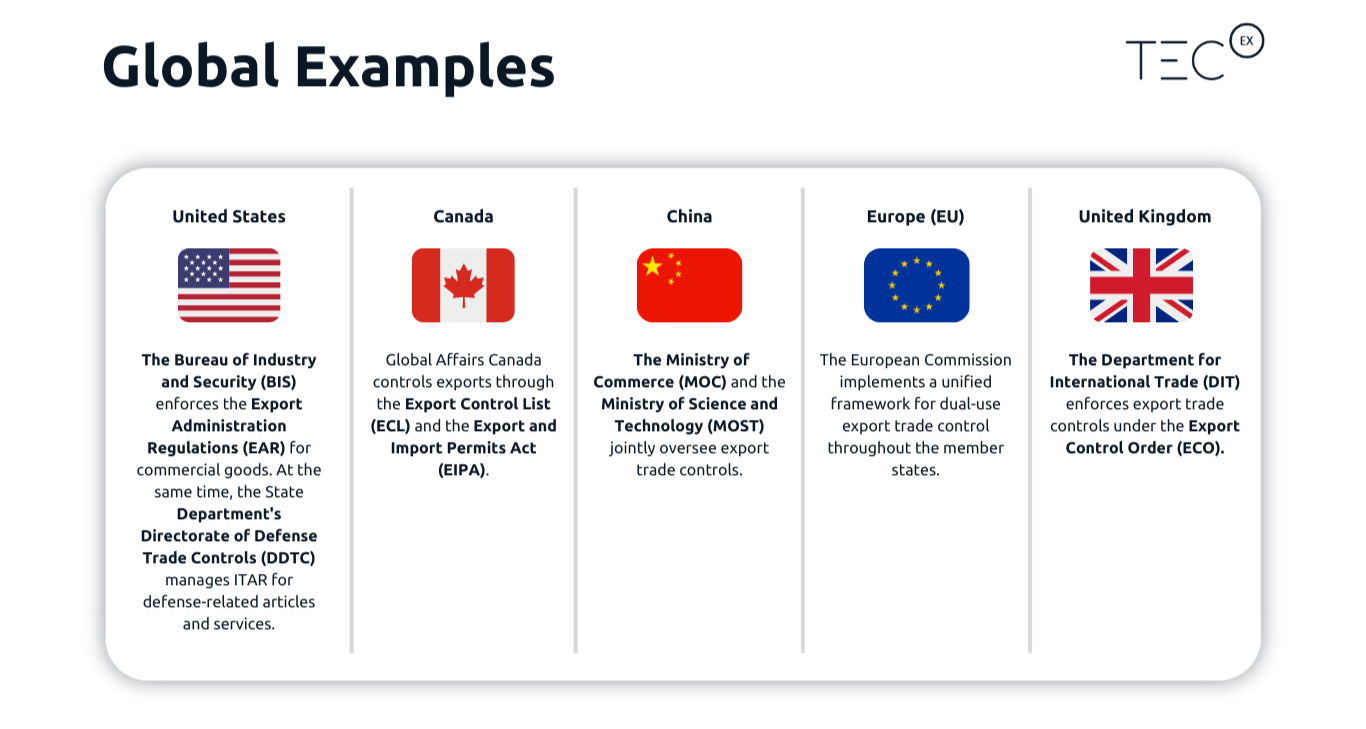
While international frameworks encourage alignment, there is no single global standard. Regulations vary significantly based on each country’s security priorities and foreign policy goals.
Stay Compliant When Shipping Dual-Use Goods
Understanding why certain products are classified as dual-use goods is the first step to ensuring shipping compliance.
By understanding classification rules, staying up to date with all regulations, and partnering with an Importer of Record, businesses can confidently move tech products across borders stress-free.