Import to Asia
Asia remains the engine of global trade, driving roughly 60% of global growth. But beneath that headline figure lies a more nuanced compliance environment.
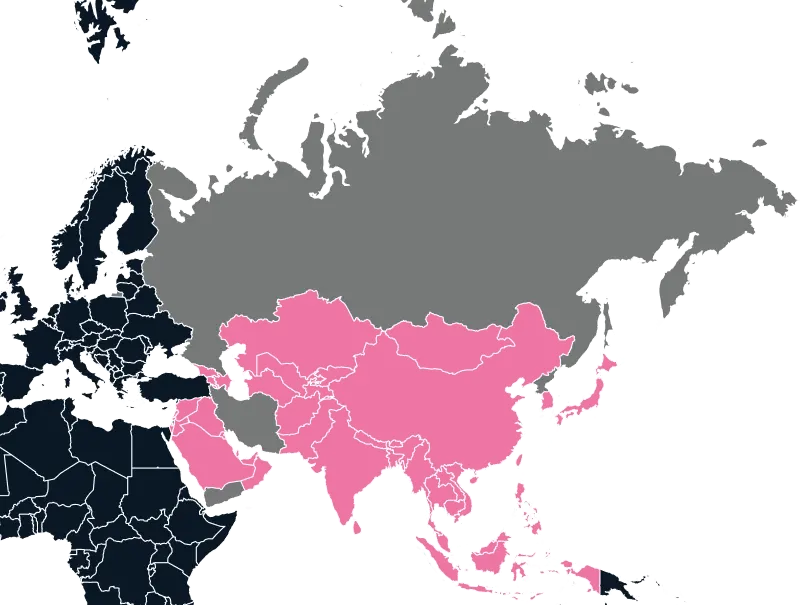
Asia remains the engine of global trade, driving roughly 60% of global growth. But beneath that headline figure lies a more nuanced compliance environment.
From AI-powered supply chains to increasingly strict customs regimes, Asia presents both massive opportunities and equally significant complexity. That’s where a modern approach to Asian trade compliance becomes your competitive edge.
For businesses focused on importing to Asia, understanding the nuances of this new environment is no longer optional
Explore the customs requirements, regulatory frameworks, and trade agreements affecting each Asian country.
Asia, home to over 4 billion people, stands as one of the world’s most powerful economic regions. Its technological advancements, industrial growth, and expanding middle class have led to an unprecedented demand for goods, especially in sectors like technology.
From the dynamic markets of Southeast Asia to the cutting-edge hubs of East Asia, the opportunities for trade are vast. However, exporting or importing goods in this region presents a unique set of challenges.
Asia’s thriving tech industry is a goldmine for tech supply chains, but navigating customs clearance can be a complex maze. A plethora of nuanced complexities can come into play when looking to trade into and out of this region. From geopolitical tensions and subsequent trade restrictions to inelastic supply lead times and increased demand (particularly within the AI industry).
East Asia continues to dominate high-tech manufacturing. Countries like China, South Korea, Taiwan, and Japan are leading the global charge in semiconductors, AI hardware, and advanced electronics.
AI-related exports alone have grown by over 20% year-on-year, reflecting the region’s pivot toward high-margin, innovation-driven goods.
On the import side, the story is just as dynamic. Developing economies across Asia are importing record volumes of:
India and Indonesia, in particular, are rapidly scaling their industrial bases, creating new demand corridors for global exporters.
One of the most important shifts is the rise of intra-Asian trade. Regional trade is now growing faster than trade with Western markets, supported by trade agreements that reduce reliance on the US dollar and streamline cross-border flows.
While Asia offers incredible trade opportunities, businesses must overcome significant hurdles. Supply chains have stabilized post-pandemic, but new friction points have emerged, many of them more complex and less predictable.
One of the main challenges is the complexity of customs compliance. Each country in Asia has its own set of regulations and certifications, and understanding these requirements is essential to avoid costly delays. For example, regulations like Hong Kong’s HKTID certification or India’s EPR policy can significantly impact the speed and cost of trade if not properly navigated.
Geopolitical instability further complicates matters. Tensions in regions such as the South China Sea or the Korean Peninsula can lead to sudden changes in tariffs, trade restrictions, or even embargoes, creating an unpredictable environment for businesses. The supply chain, particularly in the tech sector, is also a concern. High demand and limited capacity in some manufacturing hubs can lead to delays, making it difficult to forecast lead times and manage inventory.
Another challenge is understanding the diverse tariffs, taxes, and trade agreements that vary across the region. With multiple agreements and trade blocs such as RCEP, ASEAN, and the GCC, navigating these can be tricky. Misunderstanding the interplay between these rules can result in compliance issues, delays, or additional costs.
High-value goods, especially those tied to advanced technologies, are facing increased scrutiny.
Regulatory complexity is rising sharply across the region.
For companies importing to Asia, these challenges can quickly turn into costly disruptions without the right compliance infrastructure.
The complexities of trade in Asia make it crucial to partner with an expert who understands the region’s regulations, certifications, and customs processes. TecEx specializes in offering solutions that help businesses navigate these challenges.
We provide Importer of Record (IOR) services to ensure smooth customs clearance, offer expertise in customs compliance to keep you up-to-date with the latest regulations, and deliver end-to-end solutions that support your business from shipment planning to final delivery.
With TecEx as your trusted partner, you can overcome the hurdles of Asian trade compliance and unlock the region’s immense market potential.
We centralize product classification, valuation, and documentation processes to ensure every shipment meets evolving regulatory requirements. From origin verification to screening, we proactively identify compliance risks before they cause delays.
By leveraging predictive analytics, we also help reduce the likelihood of red channel inspections and minimize clearance times. Our solution is continuously evolving to reflect the latest changes in Asian trade regulations, from data localization laws to FTA requirements.
Trade in Asia is increasingly governed by large, interconnected agreements that emphasize digital integration and regional cooperation.
As the world’s largest free trade agreement, RCEP is simplifying cross-border trade through harmonized rules of origin. This allows products manufactured across multiple Asian countries to qualify as a single regional product—streamlining tariffs and compliance.
The Comprehensive and Progressive Agreement for Trans-Pacific Partnership sets the benchmark for digital trade and intellectual property protections. It’s particularly relevant for tech companies operating in Japan, Vietnam, and Malaysia.
The ASW initiative is transforming customs processes by enabling electronic document exchange across ASEAN nations. Its upgrades include AI-driven “trusted trader” systems, rewarding compliant businesses with faster clearance.
Hong Kong continues to play a pivotal role as a gateway between China and global markets. Its expanding network of trade agreements reinforces its position as a key logistics and financial hub.
Asia’s economic transformation is being driven by next-generation industries that are reshaping global supply chains.
Malaysia, Taiwan, and South Korea are leading the charge. Malaysia’s Johor region has emerged as Southeast Asia’s data center capital, while Korean firms dominate the production of high-bandwidth memory chips essential for AI systems.
Thailand and Indonesia are becoming global EV hubs. Indonesia’s nickel reserves are fueling battery production, while Thailand continues to attract billions in EV manufacturing investment.
Singapore and India are at the forefront of quantum-safe cybersecurity. With over 90% of APAC firms investing in post-quantum cryptography, this sector is rapidly becoming mission-critical.
China’s Greater Bay Area is pushing forward with fully automated “lights-out” factories, addressing labor shortages while boosting efficiency.
These industries are not only driving exports, but they’re reshaping import requirements, compliance standards, and customs classifications across the region.
Ship to Asia
Asia offers unparalleled growth opportunities, but only for companies that can navigate its complexity with precision. With the right compliance partner, you can move faster, reduce risk, and fully capitalize on the region’s potential. Contact TecEx today.
Asia offers unparalleled growth opportunities, but only for companies that can navigate its complexity with precision. With the right compliance partner, you can move faster, reduce risk, and fully capitalize on the region’s potential. Contact TecEx today.

Our upcoming webinar will dive into why cargo cover is more important than ever for high-value tech crossing borders, and how our solution keeps it safe throughout its journey.
Stay up to date with the latest news and insights on international trade, global deployment, and industry changes with TecEx’s monthly newsletter.
© Copyright 2026 - TecEx. All Rights Reserved
Privacy Policy Supplier Code of Conduct Terms and Conditions