For companies shipping high-value equipment across borders—servers, semiconductors, advanced manufacturing tools, networking hardware—the transfer of risk is one of the most commercially significant moments in any transaction. Yet it is still frequently misunderstood, misaligned with insurance, or treated as a purely legal technicality.
Transfer of risk determines who absorbs loss when cargo is damaged, delayed, or destroyed. In the tech sector, those losses can be material at both operational and balance-sheet levels.
How does risk transfer work in practice, why does it matter disproportionately in high-value technology supply chains, and how can it be managed deliberately rather than by happenstance?
Transfer of Risk Is a Physical Event, Not a Financial One
One of the most persistent misconceptions in global trade is the belief that risk transfers when money changes hands. It does not.
Transfer of risk occurs at a specific physical point in the logistics flow, defined contractually, regardless of:
- When payment is made
- Who arranged the transportation
- Who issued the invoice
- Who technically “owns” the goods at that moment
This distinction becomes critical when something goes wrong mid-journey—which, in complex global tech supply chains, is a high possibility.
If damage occurs after the transfer of risk, the buyer bears the loss. If it occurs before, the seller does. Everything else—freight responsibility, insurance arrangements, commercial goodwill—is secondary.
Why Transfer of Risk Hits Harder in the Tech Industry
High Value Concentration
Technology shipments often carry extreme value density. A single container or air shipment can represent:
- Millions of dollars in hardware
- Months of lead time
- A bottleneck for production or deployment
When transfer of risk is misunderstood, even minor incidents can escalate into uninsured losses with outsized financial impact.
Fragility and Sensitivity
Many technology products are especially vulnerable to:
- Shock and vibration
- Temperature and humidity fluctuations
- Electrostatic discharge
- Improper handling during transshipment
Risk exposure is not theoretical; it is structural.
Tight Deployment and Production Timelines
In sectors like semiconductors, cloud infrastructure, and advanced manufacturing, delays caused by damaged or lost equipment can:
- Idle factories
- Delay customer launches
- Breach contractual SLAs
- Cascade across global operations
Risk transfer determines who bears the cost of these disruptions.
The Structural Reality of Risk Allocation in Trade Terms
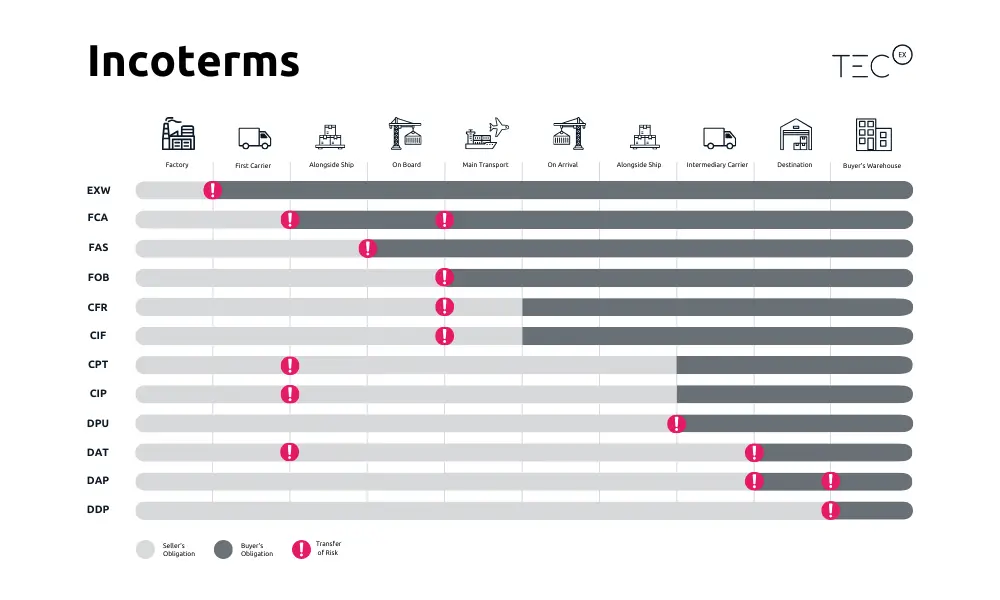
It is essential to understand how trade terms structurally allocate risk. Across commonly used Incoterms, risk transfers at one of four general stages:
| Group Stage | When Risk Transfers | Incoterms Involved |
|---|---|---|
| Group E | At the seller’s premises: Risk passes to the buyer as soon as goods are made available, placing maximum operational and compliance responsibility on the buyer from the very start. | EXW: Ex Works |
| Group F | When goods are handed to a carrier: Risk shifts at the point the seller delivers the goods to the nominated carrier, balancing the seller's control over export with the buyer's control over main transport. | FCA: Free Carrier
FAS: Free Alongside Ship (sea freight only) FOB: Free on Board (sea freight only) |
| Group C | Seller pays transport, buyer bears the risk: Although the seller pays for freight, risk transfers early in the journey, exposing the buyer during transit unless insurance and liability are tightly aligned. | CFR: Cost and Freight
CIF: Cost, Insurance and Freight CPT: Carriage Paid To CIP: Carriage and Insurance Paid To |
| Group D | Near or at final destination: The seller retains risk through most or all of the journey, transferring it only at destination delivery, often including import clearance, providing maximum certainty for the buyer. | DAP: Delivered at Place
DPU: Delivered at Place Unloaded DDP: Delivered Duty Paid |
Each structure creates very different exposure profiles, especially when applied to high-value technology cargo.
The Most Common (and Costly) Risk Misalignments
Seller Pays Transport, Buyer Bears the Risk
One of the most frequent surprises for technology buyers occurs when:
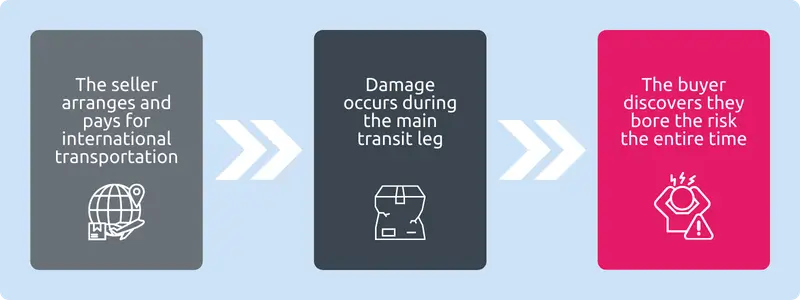
This structure is common and legitimate, but often poorly understood internally. Without aligned cargo insurance, buyers may find themselves exposed precisely where they assumed protection existed.
Insurance That Starts Too Late—or Ends Too Early
Cargo insurance must align precisely with the transfer of risk. In technology supply chains, mismatches often occur when:
- Insurance attaches after the risk has already transferred
- Coverage limits do not reflect actual replacement values
- Policy terms exclude common tech-specific risks
Insurance does not override the transfer of risk; rather, it responds to it.
Legacy Practices Applied to Modern Logistics
Many organizations continue to rely on trade practices that made sense decades ago but no longer align with modern containerized or air freight.
For example, risk transfer points originally designed for bulk maritime shipping are still applied to containerized tech cargo, creating ambiguity around:
- Who controlled the goods
- When damage likely occurred
- Which party must pursue recovery
In high-value disputes, ambiguity almost always favors insurers, not shippers.
Transfer of Risk as a Governance Issue
For large technology companies, transfer of risk is no longer just a logistics decision. It is a governance issue.
Financial Reporting and Exposure
Public companies and hyperscalers must account for:
- Potential uninsured losses
- Inventory exposure in transit
- Risk concentration across global routes
Clear, standardized risk transfer policies reduce uncertainty and support defensible financial controls.
Cross-Functional Alignment
Transfer of risk sits at the intersection of:
- Procurement
- Legal
- Logistics
- Insurance
- Finance
When these teams operate with different assumptions, gaps appear. Those gaps are where losses live.
Regulatory and Contractual Scrutiny
As global trade faces increasing regulation and geopolitical complexity, poorly defined risk transfer points can complicate:
- Dispute resolution
- Compliance investigations
- Customer and supplier negotiations
Precision is no longer optional.
Best Practices for Managing Transfer of Risk in Tech Supply Chains
Leading technology companies approach risk transfer deliberately, not reactively. Common best practices include:
Risk Moves Faster Than Paperwork
In global technology supply chains, goods move quickly. Risk moves with them.
Understanding and managing transfer of risk is not about legal theory. It is about operational resilience, financial protection, and strategic control. Companies that treat it as a core supply-chain design decision consistently outperform those that discover its importance only after something goes wrong.
For technology companies operating at scale, the most effective strategy is often not to optimize risk transfer mechanics—but to remove the exposure altogether by placing it with a partner designed to absorb it.
As a third-party DDP shipping and compliance partner, TecEx does exactly that. We take ownership of the risk, so you don’t have to. Reach out today and find out how you can ship your goods with minimal risk.