Africa is no longer a future opportunity in digital infrastructure. It’s happening now. Across the continent, a powerful shift is underway as countries invest in data centers, cloud ecosystems, and connectivity. What was once a region heavily reliant on overseas data hosting is rapidly transforming into a self-sustaining digital economy.
For global technology companies, this presents one of the most compelling growth frontiers of the next decade.
Breaking the Technological Status Quo In Africa’s Data Center Market
Africa’s data center industry is expanding at double-digit rates, driven by rising internet penetration, mobile adoption, and the growth of digital services. From fintech and ecommerce to streaming and AI, demand for data processing and storage is accelerating fast.
Historically, much of Africa’s data was hosted in Europe or other regions. Today, that model is shifting. Governments and regulators are prioritizing data sovereignty, requiring companies to store and process data locally. This has triggered a wave of investment in local infrastructure.
At the same time, global hyperscalers and cloud providers are entering the market, building regional hubs and edge locations to serve Africa’s growing digital population.
What’s Driving Africa’s Digital Revolution?
Africa has one of the youngest and fastest-growing populations in the world. With mobile-first adoption dominating, millions of new users are coming online each year. This creates massive demand for cloud services, streaming platforms, financial technology solutions, and AI and data-driven applications.
Three key metrics drive the digital infrastructure demand in Africa
Data Sovereignty and Localization
Data sovereignty refers to how the stored data is subject to the laws and governance structures from where it’s collected. As more African governments pass data protection laws, sensitive data must be stored in-country. While this introduces compliance requirements, it also guarantees long-term demand for local data centers.
Liberalization of the Telecoms Industry
Open and carrier-neutral telecom markets drive down network costs, which attracts more users. While this will vary across countries, it has pushed the increase in data consumption and increase competition on the continent.
Network Latency
New subsea cables and expanding fiber networks are improving connectivity across the continent. Combined with 5G rollout, this is enabling faster, more reliable digital services and increasing the need for localized data processing. Edge computing, or keeping servers close to users, improves network performance and reduces latency, leading to a better customer experience, stronger security, and better functionality.
Investing in Africa’s Data Center Market
A study in Senegal found that 3G internet coverage comes with a 14% increase in consumption and a 10% decrease in poverty. The relationship between internet access, human welfare, and economic potential cannot be forgotten when investing in the continent.
Hyperscalers, Microsoft and Amazon have brought their cloud services to South Africa. Chinese telecom giant Huawei helped build a data center for the Senegalese government. Both Google and Facebook have invested in new subsea cable technology, thereby broadening the available points of presence along the west coast of Africa.
Data center powerhouse Equinix has acquired MainOne and its MDXi subsidiary in a $320 million deal, thus leading the way in the West African data center market with a presence in Nigeria, Ghana, and Côte d’Ivoire. Teraco, which has recently been acquired by another major player in data center capacity, Digital Realty, is building Africa’s largest data center in South Africa. And the list goes on.
Companies that enter early can establish dominant positions as the ecosystem matures.
A North-South Divide
Overall, more than 30 Tier III data center facilities have come online in Africa since 2016. Historically, the capacity is unevenly spread across the countries, with most of the data centers sitting within South Africa. However, this North-South divide is not set to last as Nigeria, Kenya, Egypt, and Morocco follow in capacity.
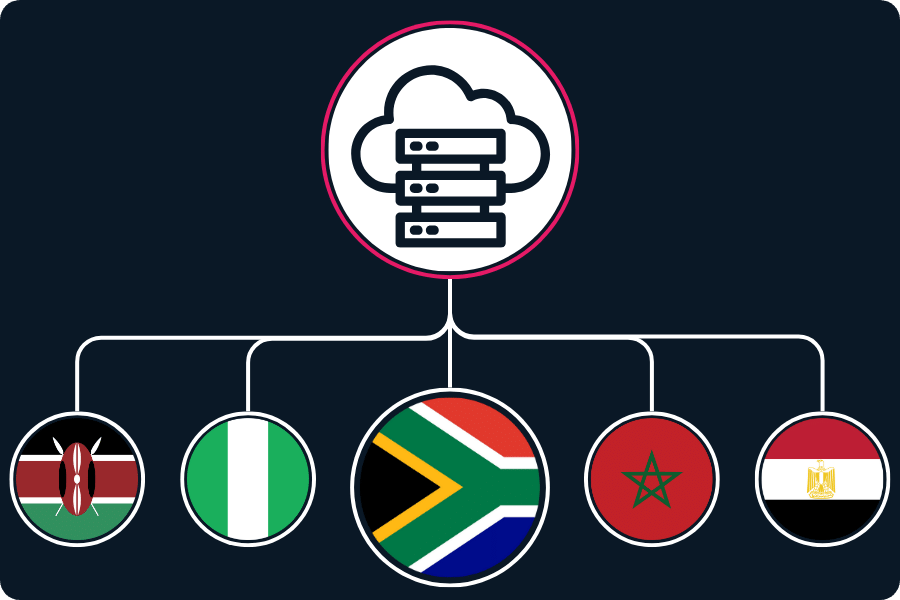
Interestingly, Nigeria is targeted to be the most exciting country in terms of digital expansion. Nigeria has the largest GDP in Africa as well as a relatively strong digital native population. Microsoft has partnered with the Nigerian government to launch projects aimed at upskilling Nigerians and promoting digitalization across the country.
The Strategic Shift | How Companies are Entering Africa
This is no longer a simple expansion. It’s a localized, partnership-driven approach.
Understanding Africa’s Data Center Market Challenge
It is essential to understand diversity when looking at the African continent. It is rich in diverse groups, differing economies, and different environments. That said, the path to developing data centers in Africa will differ from those taken by the rest of the world.
Data centers are power-hungry. Keeping the equipment cool uses a lot of energy. Meanwhile, access to a reliable power source is limited in most African countries. However, this is where African ingenuity steps in. For example, 21st Century Technologies, an ICT solutions provider, has the largest solar farm powering a data center in Nigeria. Whilst in South Africa, Eskom, a parastatal utility, has announced a $7 billion investment in renewable energy over the next nine years.
While the opportunity is significant, operating in Africa comes with complexity—particularly in logistics, compliance, and trade.
Import and Export Complexities
Bringing data center equipment into African markets can be challenging. Many countries require a local Importer of Record, meaning foreign companies must establish a local presence or partner with in-country entities.
Additionally, certain technologies, such as servers and networking equipment, may be classified as dual-use goods, triggering additional layers of regulatory approval.
Tariffs and Cost Volatility
Tariffs on ICT equipment and construction materials vary widely between countries and can change quickly. This creates cost uncertainty for large-scale infrastructure projects.
Regulatory and Compliance Burdens
Companies must navigate multiple layers of regulation, including:
- Data protection and sovereignty laws
- Telecom licensing requirements
- Product certification and standards approvals
These processes are often fragmented and, in some cases, still manual.
Logistics and Infrastructure Constraints
Transporting high-value equipment across the continent involves risks such as:
- Port congestion and delays
- Limited transport infrastructure in some regions
- Security concerns in certain logistics corridors
Despite this, the benefits of getting into Africa far outweigh the costs. The potential within this continent is vast.
Africa’s digital economy is growing rapidly, and the demand for data infrastructure is only increasing. As regulatory frameworks mature and trade agreements like the African Continental Free Trade Area (AfCFTA) gain traction, many of today’s barriers are expected to ease.
Getting Your Data Center Gear into Africa
Africa’s data center market and digital revolution represent one of the most exciting opportunities in global technology today. While challenges exist, they are increasingly being addressed through innovation, partnerships, and policy evolution.
No matter which African country you would like to expand into, you will need an IOR to get your gear through customs compliantly.
TecEx can step in, form part of a resilient supply chain, and get your critical hardware through customs seamlessly and straight into a data center. Our hassle-free solution enables you to seamlessly deploy mission-critical tech to data center facilities globally without needing a locally registered entity for import. Utilizing the DDP shipping terms, we can securely and compliantly ship gear into Africa’s data center market.
Africa is on the precipice of its digital revolution!