What are Harmonized System (HS) Codes?
HS codes are the foundation of seamless global trade. They are crucial for the classification of goods and play a key role in ensuring customs documents are accurate. They define applicable export controls and import permits, dictate duties and taxes, and determine whether imports qualify for trade agreements or preferential treatment.
TL;DR
- HS codes, based on a product’s materials, functions, and origins, classify items for customs purposes.
- Minor product differences (or different import countries) can mean different codes.
- Your code determines duties, tariffs, export controls, and import rules.
- Get it wrong, and shipments get stuck, inspected, or seized.


What is an HS Code?
The Harmonized System (HS) is a universal numerical nomenclature developed and maintained by the World Customs Organization (WCO) to classify traded goods. The WCO updates the system every five years to keep up with evolving trade, technological advancements, health and safety concerns, environmental challenges, anti-terrorism policies, and border security concerns.
If the Harmonized System is the language of global trade, HS codes are its words.
Harmonized System codes are standardized 6-digit numbers that enable customs officials to identify imported products. They simplify customs procedures, prevent stuck shipments, and ensure accurate duty calculations. The correct HS code is determined by product type, country of origin, and other factors. It corresponds to the applicable tariff rate, import regulations, and export controls.
When importers use inaccurate product classification numbers, they end up paying the wrong duties, following the incorrect rules of origin, and sourcing incorrect documents, resulting in reputational damage, financial penalties, and seized goods.
Not certain how to classify your products accurately? Don’t let misclassifications disrupt your supply chain.
HS Codes vs. Commodity Codes
Some countries and regions add digits after the internationally recognized six-digit Harmonized System code to form longer commodity codes for more detailed classifications. For example, the US adds four digits to HS codes to create Harmonized Tariff Schedule (HTS) codes (for imports) and Schedule B codes (for exports).
In HTS codes, the first two additional digits define the ‘tariff rate line’, which determines the applicable tariff rate, and the last two digits are the ‘statistical suffix’, which refines the classification and helps in data collection.
In America’s Schedule B codes, the last four digits are government-specific and used for the detailed analysis of exports rather than imports.
What Are HS Codes Used For?
The Harmonized System enables customs officials to identify imported items, apply duties, enforce regulations, and record trade data. They are central to customs declarations and influence tariff rates, Free Trade Agreements (FTAs), preferential treatment, and specific duties such as anti-dumping or CBAM.
HS codes are used for a range of trade processes, including:
According to the WCO, over 98% of commodities in international trade are classified according to the Harmonized System. These codes cover thousands of commodity groups, from ecommerce products to medical equipment and data center gear.

HS codes must be precise, as classifications largely depend on an item’s primary use. For example, different HS codes would need to be used for integrated GPUs, discrete GPUs, specialized GPUs, bare chip GPUs, and HPC GPUs.
HS codes also determine the applicable import duties and whether products qualify for preferential treatment. For example, Free Trade Agreements (FTAs) and Most Favored Nation (MFN) tariffs are usually set based on HS code classifications. Using the correct HS code is key to qualifying for lower duties.
How do Customs Officials use HS Codes?
HS codes streamline clearance processes by enabling customs authorities to quickly identify products, apply the appropriate duties, and collect trade data. This improves oversight of imports and exports, reducing the risk of misinterpretation, which is vital for dual-use goods.
What Happens If You Use The Wrong HS Code?
Selecting an HS code for traded goods is a legal requirement, and accuracy is crucial; an incorrect code cannot be selected with the intent to circumvent duties or export control regimes.
Inaccurate codes are a major contributor to stuck shipments. If the wrong code is used, the shipment risks over- or underpayment of duties, delays due to lengthy inspections, and hefty fines and penalties. This can be a significant setback for tech project timelines and budgets.
In 2024, a company importing solar panels (HTS code 8541.43.00) from China misclassified them as LED lights (HTS code 8539.52.00). The error resulted in nearly $1.1 million in duties and penalties for negligent misrepresentation.
Using the wrong HS code can result in:
The Importer of Record is responsible for using the accurate HS code. When importing under your own entity, you assume all of this risk and responsibility. An expert trade compliance partner with in-depth knowledge of the nuances of modern technologies, TecEx ensures accurate product classifications.
Why Are HS Codes Important?
Universal Classifications
HS codes allow for clear communication between customs authorities in different countries, serving as a universal language for categorizing goods and reducing soft inefficiencies.
Duties and Taxes
Using HS codes, importers can calculate the correct customs duty payable on imported goods, enabling efficient budgeting, forecasting, and financial planning.
Trade Statistics and Policy
Governments use HS code data to analyze trade flows, plan policy, and regulate internal taxes and controlled goods.
Simplified Customs Processing
HS codes determine what regulations apply to a shipment, from export controls to necessary import permits. With standardized codes, importers and exporters can prepare for customs and ensure they source the correct documents, licenses, permits, and certifications.
Trade Strategies
HS codes guide decisions on tariff engineering and sourcing, enabling businesses to evaluate materials, costs, and export destinations to optimize their budgets. Tariff engineering means designing a product with a specific HS code in mind.
Common HS Codes Challenges and Solutions in Tech Trade
The Harmonized System is complex to navigate, and a slight mistake can also have significant consequences. Let’s take a look at some of the challenges.
Accurate Classification
One of the biggest challenges in using HS codes is ensuring the correct code is used. There are many codes to choose from, and similar tech gear with minor differences can have distinct codes.
Staying Up to Date
The HS codes are periodically updated, and importers must stay informed about these changes. Despite these updates, rapidly advancing technology can be hard to align with existing codes, which may not yet accommodate the latest innovations.
Managing HS Code Data
Managing large amounts of HS code data that are subject to change can be risky. Not only can this lead to potential stuck shipments, but unforeseen changes in duties can impact your bottom line.
Regional Differences
Different countries may interpret HS codes differently or require additional digits for more specific classifications. Understanding these nuances is essential, especially when trading with multiple countries, as the same item may have a different code in different regions, such as the EU versus the US, if the intended use and essential character of the item are interpreted differently. This is where a customs specialist can guide you through the complexities and manage the entire process.
As AI technology evolves, product classifications become more nuanced and complex. The risks of misclassification are increasing as brand-new, high-value tech could get stuck, seized, or even destroyed. TecEx’s compliance database ensures that each and every product we ship is accurately classified to prevent confusion at customs.
How To Ensure Accurate HS Codes | Partner with TecEx
When minor mistakes can have significant consequences, accurate product classifications are crucial. To get them right every time, importers need to:
No one expects you to become an expert in HS codes and customs compliance. Contact TecEx today and let us handle accurate product classifications for you.
Through years of experience, we have built a database of HS codes for tech products, streamlining customs compliance. TecEx helps ease the risks and responsibilities associated with importing high-value tech equipment. We classify your goods, provide upfront costings, and seamlessly move your shipment through customs.
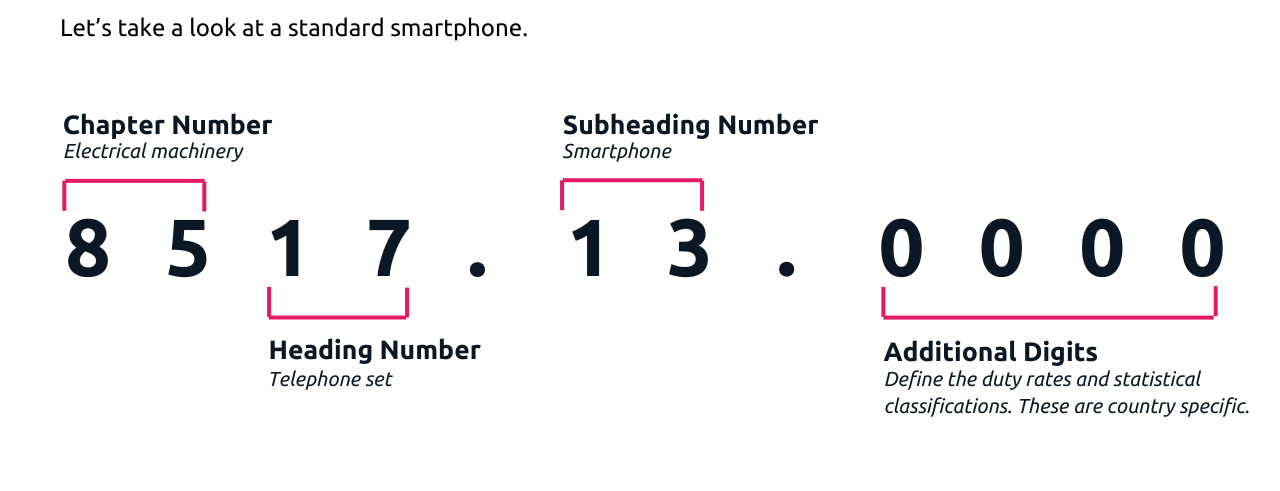
What is an Example of an HS code? | Breaking Down the Digits
Breaking Down HS Codes
| Code | Digits | Meaning |
|---|---|---|
| HS (World Customs Organization) | Chapter (1 & 2) | The broadest category your tech falls under. |
| HS (World Customs Organization) | Heading (3 & 4) | The more specific classification to describe your item. |
| HS (World Customs Organization) | Subheading (5 & 6) | The most specific level of classification in a universal HS code. |
| Country-Specific Codes | Country-dependent (7-10) | Certain countries add digits to refine product classification and collect specific data. |
HS Code FAQs
Further Readings on Product Classification


Hassle-Free Trade Compliance Solutions
As you can see from our wealth of knowledge, TecEx is your go-to partner for global trade management. With our trade compliance solutions, your IT supply chain will operate without hitting any roadblocks. We help you meet compliance requirements, navigate sanction changes, take advantage of free trade agreements, and more.
See the TecEx difference today.